AAIA-Wuhan Chapter Successfully Holds 2025 AI Frontier Forum
On November 29, the 2025 Artificial Intelligence Frontier Forum and the Ninth International Symposium on Intelligent Information Processing and Network Optimization were successfully held at the Wuhan University of Science and Technology. This forum brought together more than ten renowned experts and scholars from China, Canada, Singapore, and other countries. Together with faculty and student representatives from Wuhan University of Science and Technology, they shared an academic feast and discussed new chapters in AI development through a blended online and offline format. Chen Zhigang, Member of the University Party Committee Standing Committee and Vice President, attended and delivered a speech.
Chen Zhigang extended a warm welcome to the domestic and international experts and scholars who traveled from afar on behalf of the university. He stated that our university is always committed to serving major national strategic needs, attaches great importance to the development of AI-related disciplines, and has made strategic plans. Significant achievements have been made in related fields, and there is a clear plan for future development. He sincerely hoped that this forum would enhance exchanges, provide valuable guidance and insights for the development of AI-related disciplines at the university, inject new momentum, broaden horizons for talent cultivation, inspire new ideas for scientific research, and jointly contribute to the advancement of related industries.
Professor Xianyi Yang, Fellow of the Canadian Academy of Engineering and professor at the University of Guelph, delivered the opening keynote titled "Bio-inspired Intelligent Control of Autonomous Underwater Robotic Systems." He systematically explained the application of bio-inspired intelligent control in scenarios such as path planning and multi-robot cooperation for underwater robots, providing new ideas for intelligent system design. Professor Changyun Wen, Fellow of the Academy of Engineering, Singapore and professor at Nanyang Technological University, presented a report on "Event-triggered Cooperative Adaptive Optimal Output Regulation for Multi-agent Systems under Switching Network." He proposed event-driven distributed observation and control methods for the output regulation problem of multi-agent systems under switching networks.
Professor Jing Xu from Tsinghua University presented on "Robot Visual-Tactile Perception and Intelligent Manipulation." Addressing the challenges of robot operation in unstructured environments, she proposed vision-tactile related methods to achieve multimodal perception and solve issues like "imprecise sensing." Professor Di Guo from Beijing University of Posts and Telecommunications discussed "Large Model Multi-agent System Empowered Robot Interaction." He explored using agent collaborative planning to connect virtual and physical worlds, addressing current shortcomings in agent interaction.
Professor Lijun Zhu from Huazhong University of Science and Technology focused on "Motion Control and Planning for Legged Robots." He highlighted their advantages in unstructured environments and technical challenges, sharing recent research achievements from his team. Professor Haitao Zhang from Huazhong University of Science and Technology presented "Optimal Reward Function Design for Reinforcement Learning in Embodied Multi-agent Systems." Tackling the difficulty of reward function design in embodied reinforcement learning, he proposed a bi-level optimization framework to accelerate policy optimization and enhance task adaptability, which has been applied to unmanned surface vessel cluster tasks.
Professor Xuebo Zhang from Nankai University elaborated on "Rapid Exploration of Unknown 3D Environments by Robots Based on Dynamic Topological Graph Representation." Focusing on the efficiency and quality of robot autonomous exploration, he proposed methods related to dynamic topological graphs, setting new records for exploration efficiency in unknown 3D environments.
Associate Professor Yongbo Chen from Shanghai Jiao Tong University presented on "Applications of Topological Graph Structure in Robotics: From Navigation and Reconstruction to Embodied Intelligence." He discussed research on the application of topological graphs in robotics, exploring issues like pose graph optimization and anchor point selection, and illustrated embodied intelligence applications combined with target search tasks.
Professor Xinghai Xing from Beihang University presented "Bio-inspired Intelligent Autonomous Recovery for Unmanned Systems." He proposed a resilient decision-making framework that endows unmanned systems with autonomous recovery capabilities through bio-inspired swarm intelligence optimization and composite reward mechanisms, ensuring stable system operation in complex environments.
Professor Zhiqiang Miao from Hunan University presented "UAVs Empowering the Low-altitude Economy: From Land-Air Amphibious UAVs to UAV Clusters." He analyzed the opportunities and challenges of UAV technology in the low-altitude economy, shared research on land-air amphibious UAVs and UAV cluster cooperative control, and looked ahead to future development trends.
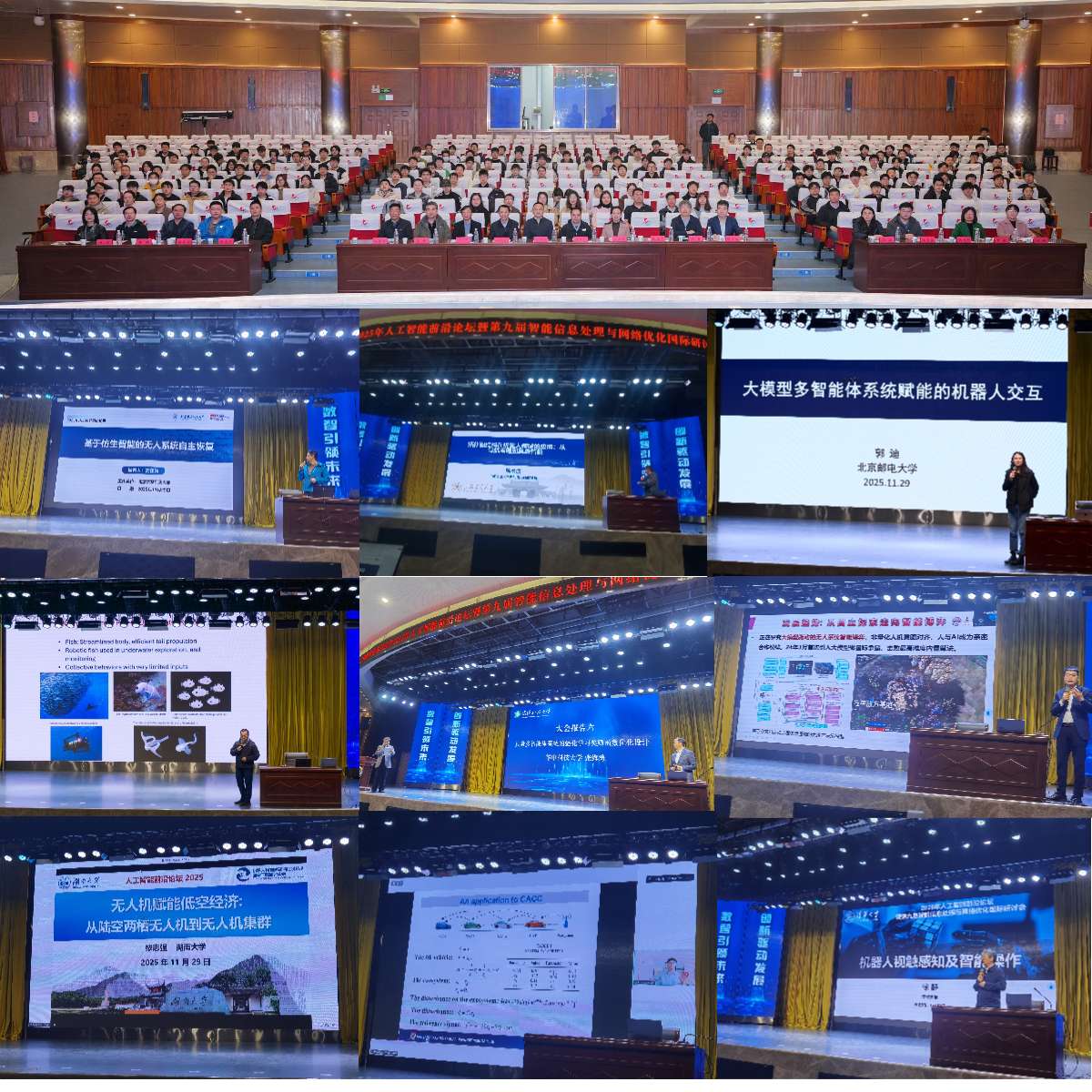
The ten high-level, forward-looking academic reports spanned from pushing the boundaries of large model capabilities to continuous breakthroughs in embodied intelligent robots, from AI-driven scientific discovery to innovations in algorithmic theory, and further to their deep integration and transformation in industrial applications. The content bridged fundamental theory and cutting-edge applications, offering both a sober examination of technological limits and an impassioned depiction of future prospects. Each presenting expert generously shared their latest research findings and unique insights, sparking deep reflection and lively discussion among the attending faculty and students.
The forum's four session chairs, Professor Yalin Wang from Central South University, Professor Li Chai from Zhejiang University, Professor Feng Dong from Tianjin University, and Professor Chuanke Zhang from China University of Geosciences (Wuhan)---with their profound knowledge and insightful commentary, skillfully facilitated each session, adding finishing touches that ignited sparks of inspiration and encouraged profound contemplation.
 International Academy of Artificial Intelligence Sciences (AAIS)